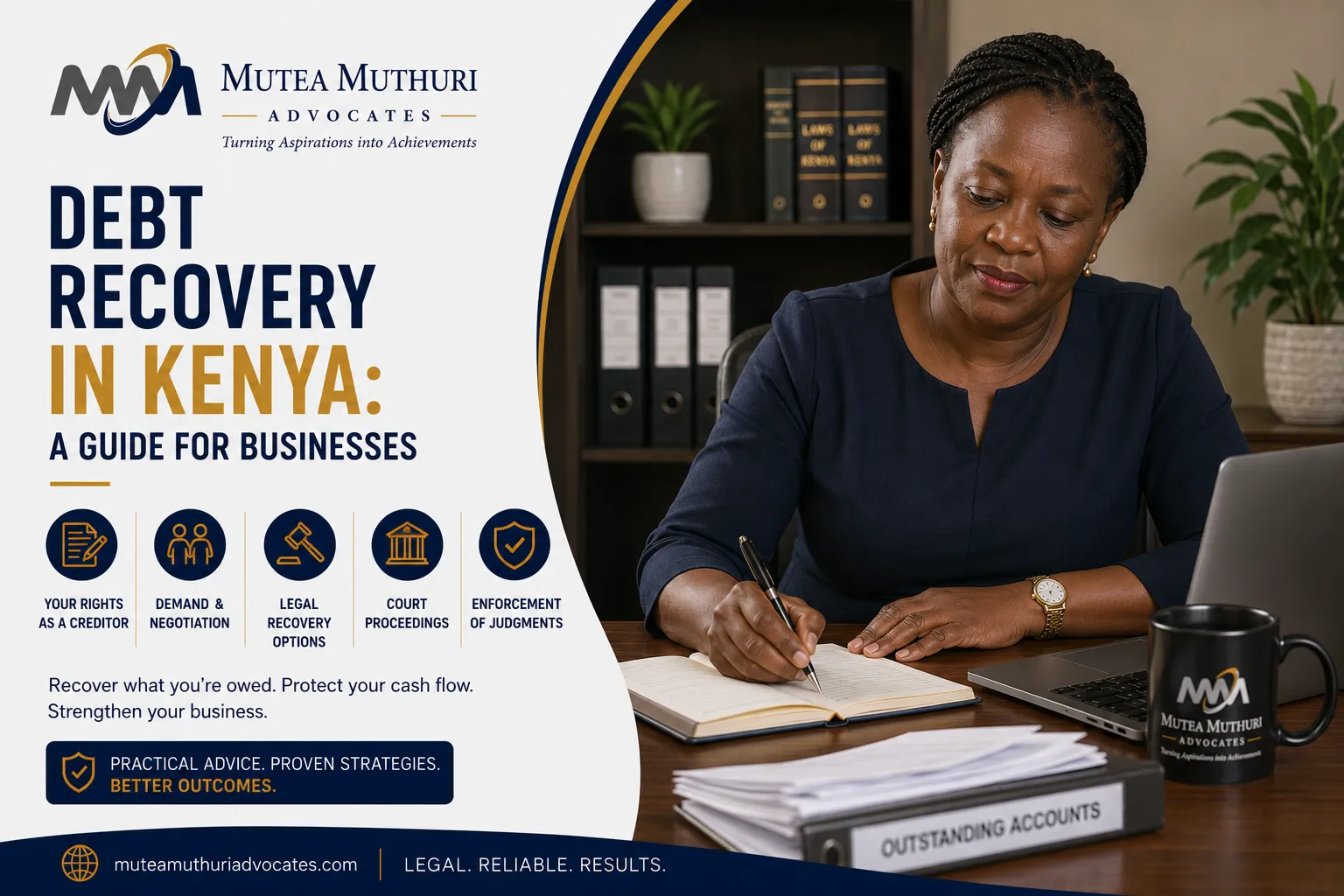
Unpaid invoices are one of the most persistent problems facing businesses in Kenya. A client who has not paid for goods or services delivered weeks or months ago is not just an accounting headache, it is a direct hit to cash flow that can affect payroll, supplier payments, and the ability to grow. Yet many businesses delay taking action, either out of a desire to preserve the business relationship or uncertainty about what legal options actually exist.
The good news is that Kenyan law provides a clear and reasonably efficient pathway for recovering unpaid debts, ranging from a simple demand letter that resolves the majority of cases, to formal court proceedings backed by powerful enforcement tools once a judgment is obtained. Understanding this pathway, and acting on it promptly, dramatically improves the chances of actually recovering what is owed.
This guide walks through the full debt recovery process in Kenya, from the first demand letter to enforcing a court judgment, along with the practical considerations that determine whether a debt is worth pursuing and which method makes the most sense for your situation.
|
Related: Civil Litigation Services - Mutea Muthuri & Associates
Related article: Commercial Contracts in Kenya
Before You Start: Assessing Whether a Debt Is Worth Pursuing
Not every unpaid debt is worth the time and cost of formal recovery action. Before deciding on a strategy, consider the following factors:
- The size of the debt relative to recovery costs - for very small amounts, the cost of legal action may exceed the amount owed. For these cases, a strongly worded demand letter is often the most cost-effective first step.
- The debtor's ability to pay - a court judgment is only valuable if the debtor has assets or income that can be used to satisfy it. Before pursuing litigation, consider what is known about the debtor's financial position. A judgment against an insolvent debtor with no recoverable assets has limited practical value.
- The strength of your documentation - the existence of a written contract, signed delivery notes, invoices, and any acknowledgment of the debt by the debtor significantly strengthens your position and speeds up the recovery process.
- The relationship with the debtor - if the debtor is an ongoing client whose business you want to retain, a more measured approach, such as a payment plan negotiated through correspondence, may be preferable to immediate litigation.
|
A signed contract, even a simple one, dramatically improves your debt recovery position. If you regularly extend credit to clients without a written agreement covering payment terms, this is one of the most cost-effective improvements you can make to your business's cash flow protection. |
Related article: How to Draft a Commercial Contract in Kenya
Step 1: The Demand Letter
A formal demand letter, sometimes called a letter of demand, is almost always the first step in debt recovery in Kenya, and for good reason. A well-drafted demand letter from a law firm resolves a significant proportion of debt disputes without the need for any further action. Many debtors who have ignored informal reminders from the creditor directly will respond promptly once they receive a formal letter on a law firm's letterhead.
What a Demand Letter Should Include
- A clear statement of the amount owed and how it arose, with reference to the relevant invoice numbers, contract, or agreement
- The date by which payment is required, typically 7 to 14 days from the date of the letter
- A clear statement that legal proceedings will follow if payment is not made by the deadline
- Reference to any interest or costs that may be claimed in addition to the principal amount
Why a Lawyer-Issued Demand Letter Carries More Weight
A demand letter issued by a law firm signals to the debtor that the creditor is serious and prepared to escalate. It also demonstrates to a court, if the matter does proceed to litigation, that the debtor was given a fair opportunity to settle before legal action was commenced, which can be relevant when costs are later awarded.
Step 2: Negotiation and Payment Plans
If the debtor responds to the demand letter but cannot pay the full amount immediately, a negotiated payment plan is often the most pragmatic outcome, particularly where the relationship with the debtor has ongoing value or where partial recovery now is preferable to the cost and delay of litigation.
Any payment plan should be documented in writing, ideally as a formal settlement agreement that acknowledges the debt, sets out the agreed instalments and dates, and specifies what happens if the debtor defaults on the plan, such as the full balance becoming immediately due and legal proceedings being commenced without further notice.
Related: Alternative Dispute Resolution - Mutea Muthuri & Associates
Step 3: Filing a Civil Suit
If the demand letter and negotiation do not result in payment, the next step is to file a civil suit for recovery of the debt. Civil debt recovery claims in Kenya are governed by the Civil Procedure Act (Cap 21) and the Civil Procedure Rules.
Choosing the Right Court
The appropriate court depends on the amount claimed. Magistrates' Courts have jurisdiction over civil claims up to a prescribed monetary limit, while the High Court handles claims above that limit. Commercial disputes of significant value in Nairobi are typically filed in the Commercial and Tax Division of the High Court, which has judges with specific experience in commercial matters.
The Pleadings Process
The suit is commenced by filing a plaint, which sets out the facts of the claim, the legal basis for it, and the relief sought, typically the principal amount owed, interest, and costs. The plaint is served on the debtor (the defendant), who has a set period to file a defense. If no defense is filed within the prescribed time, the creditor can apply for judgment in default.
Summary Judgment: A Faster Route for Clear-Cut Debts
Where the debt is clear and undisputed, for example where there is a signed acknowledgment of debt, an unpaid invoice with no genuine dispute about the goods or services delivered, or a dishonored cheque, the creditor can apply for summary judgment. This procedure allows the court to enter judgment without a full trial where the defendant has no genuine defense, significantly shortening the time to obtain a judgment.
To succeed at summary judgment, the defendant must fail to demonstrate a triable issue, meaning a genuine, arguable defense to the claim. Debtors who file a defense purely to delay proceedings, without any real basis for disputing the debt, are vulnerable to having that defense struck out and summary judgment entered against them.
|
|
Summary judgment is one of the most powerful tools in debt recovery in Kenya because it can compress a process that might otherwise take a year or more into a matter of months. Whether a particular debt qualifies depends heavily on the quality of supporting documentation, which is another reason why proper invoicing, signed contracts, and clear records matter from the outset of any business relationship. |
Recovery Method Comparison
Here is a comparison of the main routes to recovering unpaid debts in Kenya, to help decide which is appropriate for a given situation:
|
Method |
Best For |
Typical Cost |
Typical Speed |
|
Demand letter |
Most debts as the first step, especially where the relationship may continue |
Low |
1 to 3 weeks |
|
Negotiated settlement |
Cases where partial or delayed payment is acceptable |
Low to moderate |
2 to 6 weeks |
|
Summary judgment |
Clear, well-documented debts with no genuine dispute |
Moderate |
2 to 6 months |
|
Full civil suit and trial |
Disputed debts requiring evidence and witness testimony |
Higher |
1 to 3 years |
|
Small claims court |
Smaller, straightforward claims below the monetary threshold |
Low |
Weeks to a few months |
For straightforward business debts supported by clear documentation, the combination of a demand letter followed, if necessary, by a summary judgment application is typically the most efficient route. Full trials are reserved for cases where the debtor has a genuine, arguable dispute about the amount owed or the underlying transaction.
Enforcing a Judgment: Getting Paid After You Win
Obtaining a judgment is not the end of the process. A judgment is simply a court order confirming that the debt is owed; it does not automatically result in payment. If the debtor still does not pay voluntarily after judgment, the creditor must take further steps to enforce it.
Methods of Enforcement
- Garnishee proceedings - where the creditor identifies a bank account belonging to the debtor, the court can order the bank to pay the judgment amount directly from the debtor's account funds.
- Warrant of attachment and sale - the court can authorize the seizure and sale of the debtor's movable property, such as vehicles, equipment, or stock, to satisfy the judgment.
- Attachment of debts owed to the debtor - if the debtor is itself owed money by a third party, that third party can be ordered to pay the creditor directly instead of the debtor.
- Charging orders over property - for significant judgments, a charge can be registered against land or other property owned by the debtor, which must be cleared before that property can be sold or transferred.
- Winding up proceedings - where the debtor is a company that appears unable to pay its debts, a creditor can petition for the company to be wound up, which often prompts payment as companies seek to avoid the reputational and operational consequences of insolvency proceedings.
Enforcement mechanisms against companies are governed in part by the Insolvency Act 2015, which sets out the process for both corporate insolvency and the rights of creditors during that process.
|
Related article: Company Registration in Kenya: Complete Guide
Related: Banking and Security Services - Mutea Muthuri & Associates
Time Limits: Do Not Wait Too Long to Act
Under the Limitation of Actions Act (Cap 22), civil claims based on a contract, including most debt recovery claims, must generally be filed within 6 years from the date the cause of action arose, which is typically the date the debt fell due. Claims filed after this period are time-barred and the court will not entertain them, regardless of how clearly the debt is owed.
While 6 years may seem like a generous window, waiting that long is never advisable in practice. The longer a debt remains unpaid, the more likely the debtor's financial position deteriorates, assets are dissipated, witnesses become unavailable, and documentation is lost. Acting promptly, ideally within weeks or months of a payment becoming overdue, gives the best chance of full recovery.
Practical Tips to Reduce the Risk of Unpaid Debts
The most effective debt recovery strategy is preventing debts from becoming uncollectable in the first place. Practical measures include:
- Use written contracts with clear payment terms for every significant transaction, including specific due dates and consequences for late payment
- Issue invoices promptly and follow up on overdue amounts quickly rather than letting balances accumulate
- Run basic due diligence on new clients before extending significant credit, particularly for large transactions
- Consider requiring deposits or staged payments for large projects, so exposure at any point in time is limited
- Keep meticulous records of all invoices, delivery confirmations, and communications with clients regarding payment
- Act on overdue accounts within 30 to 60 days rather than allowing them to age for months
Related article: What Is a Commercial Contract in Kenya
Related: Commercial Law Services - Mutea Muthuri & Associates
Frequently Asked Questions
How do I recover an unpaid debt in Kenya?
Start with a formal demand letter giving the debtor a clear deadline to pay. If this does not result in payment, you can negotiate a payment plan or proceed to file a civil suit. For clear, well-documented debts, an application for summary judgment can produce a court judgment significantly faster than a full trial. Once judgment is obtained, enforcement mechanisms such as garnishee orders or attachment of property can be used if the debtor still does not pay voluntarily.
What is a demand letter and why does it matter?
A demand letter is a formal written notice to a debtor stating the amount owed and giving a deadline for payment before legal action is taken. A demand letter issued by a law firm carries significant weight and resolves many disputes without the need for court proceedings. It also demonstrates to a court that the debtor had a fair opportunity to pay before litigation began.
What is summary judgment in Kenya?
Summary judgment is a court procedure that allows a creditor to obtain judgment without a full trial where the debt is clear and the debtor has no genuine, arguable defense. It is significantly faster than a full civil suit and is well suited to straightforward, well-documented debts such as unpaid invoices with no real dispute about the underlying transaction.
How long do I have to sue for an unpaid debt in Kenya?
|
Under the Limitation of Actions Act, claims based on contract, including most debt recovery claims, must generally be filed within 6 years from the date the debt became due. Claims filed after this period are time-barred. However, waiting close to this limit significantly reduces the practical chances of recovery, so prompt action is always recommended.
What happens if I win a court case but the debtor still does not pay?
A court judgment is not automatically enforced. If the debtor does not pay voluntarily, the creditor must apply for enforcement, which can include garnishee proceedings against the debtor's bank account, a warrant of attachment and sale of the debtor's movable property, a charging order over real property, or in serious cases, winding up proceedings against a corporate debtor.
Is it worth pursuing a small unpaid debt through the courts in Kenya?
It depends on the size of the debt relative to the cost of recovery. For smaller claims, the small claims court process is designed to be faster and lower cost than the regular court system. For very small amounts, a strongly worded demand letter is often the most cost-effective approach, since the legal costs of full litigation can exceed the amount in dispute.
Can I claim interest on an unpaid debt in Kenya?
Yes, where the contract provides for interest on late payment, or where the court applies the statutory rate of interest on the judgment amount. Including a clear interest clause in your commercial contracts strengthens your position when claiming interest as part of a debt recovery action.
Owed Money by a Client or Business Partner in Kenya?
Whether you need a demand letter sent, a payment plan negotiated, a civil suit filed, or a court judgment enforced, Mutea Muthuri & Associates Advocates handles debt recovery matters for businesses across Nairobi, Meru, and Kenol. The longer an unpaid debt sits, the harder it becomes to recover.
Contact us today on +254 720 800 094 or visit our contact page to speak with a debt recovery lawyer in Nairobi.
|
Owed Money by a Client or Business Partner in Kenya? Mutea Muthuri & Associates Advocates handles demand letters, civil suits, summary judgment applications and judgment enforcement for businesses across Nairobi, Meru and Kenol.
|